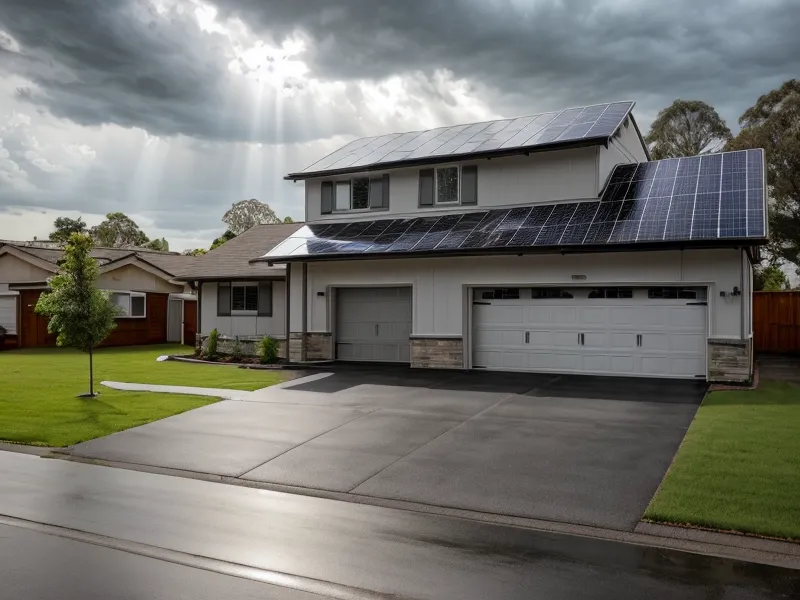
We're elbow-deep in a cooler of ice when the neighbor's generator quits mid-roar, and the quiet that follows feels louder than the rain hammering the driveway. Three days without power stops being an abstract emergency backup power problem right about then. It turns into a countdown for an insulin cooler that can't fail, a folder of client files that's due whether the grid cooperates or not, and a decision about which battery backup setup actually earns a permanent spot in our garage.
She: Every family in a hurricane zone gets the same advice eventually: buy the biggest generator or the priciest battery wall you can afford, and stop worrying. We believed that too, until reality called it what it actually is: a myth. The fix was never size. It was matching the right amount of power to the thing that actually needs it, one layer at a time, instead of betting everything on a single box in the garage.
The Biggest Battery Isn't the Safer Bet
He: I chased the myth first. After our second blackout, my instinct was to go bigger. I wanted one generator loud enough to run the whole house at once. It worked, technically, running somewhere between 72 and 80 decibels, loud enough that Cheryl, two doors down on our cul-de-sac in Pearland, could set her watch by when I fired it up. What I didn't understand yet is that a generator and a battery bank aren't rivals competing for the same job. They're teammates, and forcing one to cover both roles is how you end up with a machine that's either overkill or asleep most of the year.
She: My mistake was smaller, but it stung just as much. I grabbed a basic UPS from an office supply store, the kind meant to protect a desktop computer, and assumed it would buy me enough runtime to save my files and shut everything down properly. It didn't come close. The battery inside gave out almost as soon as it kicked on. That was the moment I stopped assuming any device labeled "battery backup" would actually do the job. A UPS built for a flicker and a system built for a three-day outage are not the same purchase.
Skip the Miracle Devices, Check the Math
He: Before we found our footing, we wasted money on one of those 'magnetic energy' devices sold in late-night ads promising free power forever. Cheryl talked us out of buying a second one — she wanted to see actual watt numbers before she'd believe any of it, and when we couldn't produce them, neither could the device. If you're curious how that particular rabbit hole ends, we broke it down separately in Orgone Motor vs Magnetic Generators for reliable emergency home power.
She: These days, before any purchase, we run rough wattage math on what actually needs to stay on, instead of shopping for whatever number sounds impressive on the box. We also stopped trusting a garage full of stored gasoline as a whole plan by itself — untreated fuel starts breaking down in three to six months, which is a short shelf life for a state where the next storm season is never that far off.
The Layered System We Built Instead
He: Instead of one giant unit sitting in the garage at full charge for eight months at a stretch, we run several smaller stations that actually get used. One stays in her office and never leaves. Another rides along to little league games or gets borrowed for a weekend outside, which keeps the cells from just sitting idle. The concrete pad behind our garage has turned into an unofficial testing ground — every new station gets run through a humid Houston afternoon and a cold snap before it earns a permanent spot on the shelf.
She: Buying small and often instead of big and once felt less like one enormous insurance policy and more like coverage that actually matches the real risk — and it helped the budget rather than hurting it. We never had to save up for one massive, expensive unit that would sit untouched most of the year. None of the smaller stations needed an electrician on-site either; they plug straight into a wall outlet. The batteries inside are Lithium Iron Phosphate cells, a chemistry we picked specifically because it doesn't carry the same fire risk as the batteries we'd grown used to trusting in laptops, and that mattered with kids sleeping down the hall.
What Does Insulin Safety Actually Require?
He: Insulin safety was never negotiable in our house, so once we stopped chasing one giant fix, the first rule we wrote down was simple: medical loads get power before anything else, full stop. That rule now decides what gets plugged in first during any outage, ahead of the Wi-Fi, ahead of the TV, ahead of my little league equipment charger.
She: A reader named Dwight found the site after our last storm and emailed with a question that stuck with me. His son runs on a home oxygen concentrator, and he didn't ask about brands or specs — he asked whether we'd actually tested our setup with real medical equipment attached, not just a laptop and a lamp. That's the right question, and it's become the one we ask ourselves in the first hour of any outage: not "is the internet back," but "what's cold, what's charged, and what can't wait." We keep the full breakdown of how we handle the fridge specifically in our guide to keeping the fridge running through an outage, but the short version is that medical needs decide the order, not convenience.
The Rule We'd Hand the Next Family in Line
He: We're not trying to disconnect from the utility company for good, and anyone selling that dream to a family with a freelance income and a kid's medication on the line is selling the wrong goal. What we wanted was a house that doesn't panic when the grid does. Our path to real home power independence reads a lot less dramatic now than the version that scared us into researching this in the first place.
She: The last time the power dropped on our street, I walked straight to the kitchen, plugged the small station into the fridge, and just stood there listening. No scramble for the cooler. No mental math running through insulin safety numbers. Just the ordinary sound of a fridge doing its job while the rest of the block lost power around us, and a set of client files still open on a screen that never blinked.
He: So here's the rule we'd hand to the next family staring at a wall of generators and battery banks this season: stop shopping for one perfect box. Figure out exactly what can't go without power in your house, size something small to cover just that, and add a layer at a time from there. No miracle device required, and no single massive purchase either — just power that matches the problem instead of promising to solve every problem at once.
Nothing on this website constitutes medical, legal, or financial advice. All content is based on the author's personal experience and independent research. Consult a licensed professional for guidance specific to your situation.