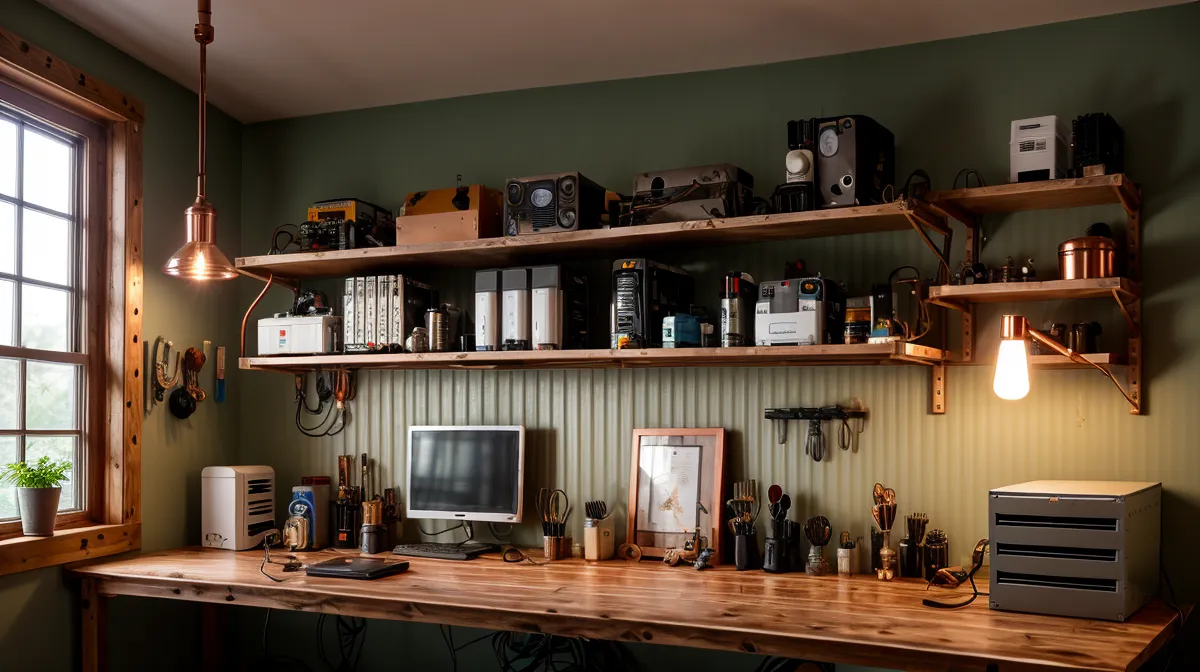
When a hurricane knocks the grid out for three days, twice in the same year, you learn what happens to a family's emergency backup plan. Ask us before you ask anyone selling you a generator. Our house sits south of Houston, and we've now lived through outages long enough that the real question stopped being about generators and started being about a kid's insulin cooler and a graphic designer's client deadlines. We're answering this the way our neighbors keep asking it: as a running list of questions, not a story with a bow on it.
Before we get into any of it: this page contains affiliate links, and if you buy something through them we earn a commission at no extra cost to you. Neither of us is an electrician or a medical professional. We're the family that got burned twice and started asking better questions, and everything below is what we've actually tested, not what a product page promised.
Why Two Blackouts Changed Our Hurricane Preparedness For Good
Two outages in one year will reorganize a family's priorities fast. The first one cost me three client deadlines because a graphic designer without power is just a person staring at a dead laptop, no WiFi router, no cloud upload, nothing moving. Whether a router and a laptop deserve their own small battery setup separate from the fridge is a fair question on its own, and one we get asked a lot. The second outage was worse, because it stretched long enough that we were watching a kitchen cooler and checking whether our son's insulin was staying within the recommended insulin storage temperature of 36 to 46 degrees Fahrenheit. Watching a thermometer do nothing useful for hours is a specific kind of helpless.
Texas runs its own power grid instead of tying into the national ones, and the ERCOT grid operating that way means that when the system buckles in a storm, nobody is quietly routing power in from a neighboring state to bail you out. Why grids fail the way they do during a hurricane is a deeper rabbit hole than we're going to dig here; the short version is that it's rarely one single thing breaking. Our neighbor two doors down, Cheryl Oduya, tracks every outage in a paper notebook she refuses to trade for an app, and her handwritten timeline has matched the utility's outage map closer than I would have expected, blip for blip.
The Cheap Inverter Generator We Regret Buying
We did what most people do first: bought a small inverter generator because it was supposed to be the quiet option. It wasn't. It ran fine on paper, and it kept the fridge alive, but it was loud enough that running it anywhere near the house overnight meant choosing between the generator or our sleeping kids, not both. We ended up shutting it off more nights than not, which defeats the entire point of having it.
Noise doesn't show up on a spec sheet, and that's the part nobody warns you about. A generator that's technically quiet enough for a product photo can still be loud enough to argue about through a closed window at midnight. That gap between the marketing and the actual decibels sitting a few feet from a bedroom wall is the whole reason we started looking at something that didn't burn fuel at all.
How Much Power Does a Family Actually Need?
Figuring out your real number is less about any single appliance and more about addition. A fridge, a modem, a laptop, one medical device; add up what each one pulls and you get a baseline most households have never actually calculated before a storm forces the question. We keep our own list where we'll actually see it, updated every time something new gets added or retired, because guessing at this number mid-outage is how systems get overloaded at the worst possible moment.
There's also a difference between what an appliance needs to keep running and what it needs to start, and that gap trips up more buying decisions than almost anything else. The jolt a compressor needs to kick on is bigger than what it needs once it's already going, and a system sized only for the smaller number will trip the instant that compressor cycles. Working out that full calculation for your own house is worth its own dedicated conversation. We're not going to shortcut it into a paragraph here.
Generator, Battery, or Both?
A gas generator gives you power as long as you can keep feeding it fuel. A battery system gives you power as long as the battery holds a charge, then nothing until it recharges. Neither answer is complete by itself, and anyone telling you one option beats the other outright is skipping the part where your situation decides it, not theirs.
Portable solar sounded like the obvious bridge between the two, and we gave it a real shot before giving up on it as our main plan. Whether a solar setup can actually keep pace without steady sun for days running is a question worth answering honestly, and in our experience that answer depends entirely on the week's weather, which isn't something you can plan a medical fridge around.
That's part of why we moved toward a modular setup instead of a fuel tank or one sealed battery box: the Energy Revolution System, which let us add capacity piece by piece rather than committing to one fixed unit.
It works off electromagnetic induction rather than burning anything, which is the short version of why there's no gas smell, no fumes, and no fuel math involved at all. We're not turning this into an electrical engineering lecture; the point for a family weighing options is simply that quiet power and maximum output tend to trade off against each other, and this one landed on the quiet side without leaving us short.
We liked that the Energy Revolution System scales instead of locking you into one box's ceiling; add a panel, add a battery, and the ceiling moves with you. That flexibility does mean more cable management than an all-in-one unit, which is the trade we'd tell any neighbor to expect going in. The concrete slab behind our garage has turned into the spot where anything new gets tested before it ever comes near the house, and the shelving just inside stays organized mostly because it has to.
The First Hour After the Power Dies
The first hour is where most of the panic happens, and it's also the hour where a plan either earns its keep or doesn't. Exactly what to check first, what to leave alone, and which outlets actually matter in that hour is a full checklist on its own that we won't try to compress here, but the short version is: know your priority loads before the lights go out, not after.
During the last real test, the Energy Revolution System kicked in through the transfer switch before either of us had to think about it, and the first thing I did was walk to the fridge, plug it back in, and just stand there listening for something that didn't come. No roar, no fuel smell, nothing rattling against the concrete out back, just the ordinary tick of a compressor doing its ordinary job. That absence of drama is the entire point.
Does Medical Equipment Change the Math?
Medical equipment changes everything about how you plan, because the stakes aren't comfort anymore, they're health. A fridge holding insulin or a machine running overnight doesn't get to be an afterthought the way a phone charger does, and any backup plan worth trusting has to put those loads first, not wherever they happen to fit.
A neighbor named Dwight Nkemdirim found this site after the last big storm, looking for a family that had actually stress-tested a setup around a kid's oxygen concentrator instead of just reading spec sheets. He's since done more wattage math by hand than most engineers do in software, cross-checking every number before trusting it near his son's equipment, and honestly, that's the right instinct. Whether the power coming out the other end is clean enough for sensitive electronics is its own question too, separate from whether there's simply enough of it.
Can You Install This Without an Electrician?
Short answer: parts of it, yes, and parts of it, no, and the dividing line matters more than most buying guides admit. Plugging a battery system into standard outlets with pre-built cables is well within normal DIY territory for most households.
Anything that touches your home's wiring directly, or any kind of permanent transfer switch setup, is where we stop and tell people to call a licensed electrician, every time, no exceptions. We're not walking through wiring steps here, partly because every house's panel is different and partly because getting that part wrong is how people get hurt or burn a house down. That's not us being cautious for legal reasons; it's us having watched a neighbor nearly back-feed a line because a generator got connected in the wrong place.
Why We're Skeptical of Energy Independence Sales Pitches
Full energy independence gets sold like a light switch: flip it and you're done worrying about the grid forever. It's actually a spectrum, and most families land somewhere in the middle of it rather than at either end; enough backup to cover the loads that matter, not necessarily enough to run a whole house indefinitely.
Any product promising free or unlimited energy out of thin air should get the same skepticism you'd give a stranger promising free money. We've looked at plenty of those claims, and the ones worth trusting are the ones that tell you plainly what the system can and can't do rather than promising you'll never think about electricity again.
Fuel itself is also a more fragile supply chain during a storm than people assume; stations run dry, lines get long, and a plan that depends on repeated trips to buy more of it has a built-in weak point. That's a real mark against anything that needs refueling, regardless of how well it otherwise performs.
Where a Neighbor Should Start With Home Power Solutions
Redundancy works best in layers rather than one big purchase, and that's the advice we'd actually give a neighbor starting from zero. A small unit for phones and WiFi, a mid-size unit for the fridge, and a bigger plan for anything medical is a more realistic ladder to climb than trying to buy one system that does everything on day one.
If you're in a condo or apartment, the Orgone Motor is a reasonable smaller option for keeping phones and small medical devices charged without needing outdoor space or worrying about ventilation indoors. If your budget is the main constraint right now, the Power Grid Generator gets you started for under fifty bucks, with the understanding that you're buying an entry point, not a whole-house solution.
How long any battery setup actually holds up over repeated charge cycles, year after year, is a separate question worth asking before you buy, and not every product answers it the same way. We've now run some version of this setup through more than one storm season, and the honest takeaway is that the right starting point depends on what you're actually trying to protect, not on buying the biggest box available.
If you've got a family, a home office, or medical equipment riding on this decision, we'd start with the Energy Revolution System and build outward from there, because it scaled with us instead of forcing us to replace it when our needs grew. Whatever you choose, test it before the next storm shows up, not during.
Energy Revolution System
Pros
- ● Reliable power for medical fridges and home offices
- ● No fuel storage or gas fumes required
- ● Highly scalable modular design
- ● Step-by-step video guides make assembly doable
Cons
- − Requires manual assembly and basic tool use
- − More cable management needed than all-in-one units
Nothing on this website constitutes medical, legal, or financial advice. All content is based on the author's personal experience and independent research. Consult a licensed professional for guidance specific to your situation.