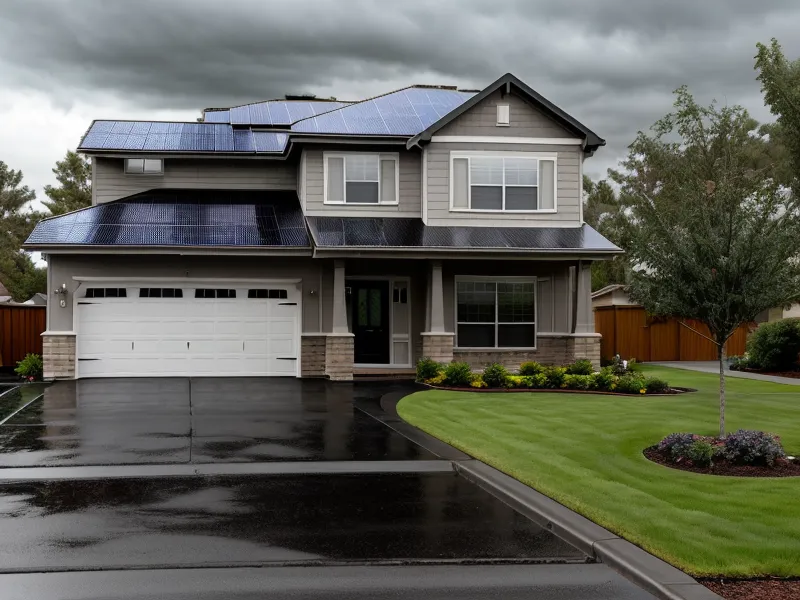
The cursor blinks on an unsent email, rain throwing itself sideways against the window, and the Wi-Fi icon on my wife's laptop drops from four bars to nothing while she is still elbow-deep in revisions for a client in New York. Tropical Storm Harold, the one we'd both shrugged off two days earlier as "probably nothing," just proved us wrong. That night is the reason our family finally built real emergency power into the house instead of hoping a backup generator sitting in the shed would somehow cover us — and why we ended up testing a battery backup too, once we realized dual-fuel machines and quiet indoor batteries solve two completely different problems, not the same one. Home resilience, it turns out, is not a single purchase. It's a system.
Quick disclosure before we get into the hardware: some of the links below are affiliate links, and if you buy something through one we earn a commission at no extra cost to you. We only point you toward backup power gear and plans our own family has actually run during real Texas blackouts, not stuff we read about once.
Why We Stopped Trusting One Single Backup Plan
Neither of us came into this knowing the difference between starting watts and running watts. She handles branding and design work for clients scattered across time zones that do not care one bit about Gulf Coast weather. He spends most evenings coaching Little League and fixing whatever broke around the house that week. We are not electricians, and we are not the kind of people who enjoy researching generators for fun.
The first real outage hit during an early-season storm warning, and the house went quiet except for thunder. Within hours the temperature inside climbed, and the thing that scared us was not the air conditioning — it was the refrigerator. Our youngest needs daily insulin, and unopened vials need to stay roughly between 36°F and 46°F to hold their potency; push them past about 86°F and they break down fast. We are not doctors, and anything insulin-specific should run through your child's actual care team, but that number is the one that kept us up that first night.
We wrote the long version of that first scramble in The Cold Chain and Client Deadlines: Practical Emergency Power Lessons from Outside Houston, if you want the ice-cooler, candle-lit-kitchen details. What matters here is the short version: when the grid came back on, we promised each other we would never again be improvising with a cooler and a prayer.
Dual Fuel Generators: Weighing Noise, Hassle, and Actual Capacity
Our first move was the obvious one. Buy a generator, point it at the house, done. Except living this close to the Gulf makes plain gasoline a liability — ethanol-blended pump gas pulls in moisture, and untreated fuel can start gumming up a carburetor in as little as three to six months sitting in a hot garage. Four five-gallon cans stacked against the wall looked like security. It was really just a countdown.
That is what pushed us toward dual-fuel units that run on either gasoline or propane. Propane sealed in a steel cylinder does not degrade the way gasoline does, so it sits ready for months or years without turning into a problem. The first time we actually leaned on one, during a transformer failure that blacked out half the block, the generator barely noticed the fridge compressor kicking on — a typical fridge pulls somewhere around 1200 watts just to start, settling to maybe 150 to 200 watts once it is running, and the dual-fuel engine ate that without stalling.
What it cannot do is stay out of the way. Even a quieter inverter-style unit runs loud enough to rattle a bedroom window and tell the whole street you still have power. You cannot run one indoors, in an attached garage, or near a cracked window because of carbon monoxide, and keeping it dry under sideways Gulf Coast rain while the cord stays clear of puddles is its own small ordeal. And when the tank runs dry at an inconvenient hour, somebody has to go outside in the weather and swap it — there is no version of that chore that feels good.
Battery Backups for Home Office and Medical Gear
While he was outside fighting with a propane hose, she was looking at high-capacity lithium iron phosphate battery stations instead. Her problem was never about running a window air conditioner. It was about her screen never going black mid-file.
A battery station sits quietly wherever you put it — under a desk, next to a crib, nowhere near an exhaust pipe — and a good one with a built-in transfer switch takes over in milliseconds when the grid drops. We have tested this during planned outages: her monitors stayed lit, the router did not reboot, and nothing got corrupted. We went deeper into what that split-second switchover actually means for a home office in Best Uninterruptible Power Supply for Home Office Desktop Computers, but here is the short version: not every battery unit switches over fast enough to matter, and that detail is worth checking before you buy.
We did not start there, though. The first thing we actually bought was a cheap UPS from an office supply store, the kind meant for riding out a quick flicker, not a real blackout. It lasted about twenty minutes before the whole thing went silent, and we were right back to candles. That one purchase taught us battery backups are not all the same tier of product, and a low price tag tells you almost nothing about how long a unit will actually hold a fridge or a monitor.
The honest limitation is capacity. A battery drains, and recharging it mid-blackout means either solar — mostly useless under thick hurricane cloud cover — or an outside power source. Stretch a cloudy outage past about forty-eight hours running a fridge on battery alone, and you will watch the meter hit zero with no backup truck coming.
Dwight, a neighbor who found our site after last year's storm season, asked us almost the same question, except with higher stakes — his son depends on a home oxygen concentrator, and he wanted a straight answer on whether a battery or a generator was the one he could actually trust. He had already done more wattage math on paper than most engineers do with software by the time he reached out, and the answer we gave him is the same one we would give you: it depends on which failure you can least afford, an instant interruption or running out of total capacity, and most medical equipment cannot tolerate the first one at all.
Savings Account vs. Checking Account: The Real Power Tradeoff
Here is how we finally explained it to each other, after enough side-by-side testing to stop arguing about which technology was "better." A dual-fuel generator is like a long-term emergency savings account. It holds real volume, enough to carry the whole house through a grinding, multi-day outage, but getting to it takes manual effort — pulling cords, standing in the weather, keeping it fed. A battery backup is more like a checking account with overdraft protection. It catches the sudden bounce instantly, without dropping a transaction, but it was never built to carry the full weight of a house indefinitely.
Lean only on the generator and your computer resets the second the grid blinks, and you will spend the first stretch of any outage in the rain hauling out a machine that weighs as much as a dog. Lean only on batteries and a long cloudy run will eventually empty the tank, with spoiled food and a freezer full of regret. Neither mistake is hypothetical. We have made both.
Closing the Gap Without Betting Everything on One Fuel Truck
The piece that actually bridges those two weaknesses is recharging the battery without depending on a gas station that may not have power either. After a bad storm, pumps go dark, roads flood, and supply trucks cannot get through for days, sometimes longer. That single fact is why we started looking past the usual generator-or-battery shelf at the hardware store.
We built our first alternative unit from the Energy Revolution System blueprint, a step-by-step plan for assembling a compact power-generating setup from parts you can source yourself, specifically meant to keep a battery bank topped off without a fuel delivery in sight. It took a weekend of garage time and basic tools, and having that extra loop running in the background changed how we felt every time a storm watch popped up on the weather app. For smaller needs — comms gear, flashlights, a dedicated medical cooler in a back bedroom — we also tried the Orgone Motor plans, small enough to live on a single shelf and sized for exactly that scale of load, nothing more. If your budget is tighter and you are comfortable with a simpler build using common hardware-store parts, the Power Grid Generator blueprint is the entry-level version of the same idea, with a more modest ceiling on output.
Pricing and what is included with each of these shifts from time to time, so check the current listing before you commit to one. If you want the fuller comparison of how we layer all of this against insulin and deadline risk specifically, we laid it out in Beyond the Gas Can: Building a Multi-Tiered Power Plan for Deadlines and Insulin.
The Family Setup That Finally Felt Like Enough
These days the choice is not either-or. It is layered, on purpose:
- Tier 1: Instant desktop and medical buffer. An indoor battery bank sits between her desk and the wall, with a small dedicated cooler nearby for insulin. The second the grid blinks, that switch happens — work stays up, the cooler stays cold.
- Tier 2: Sustained off-grid recharging. A Energy Revolution System setup in the garage keeps trickle-charging those batteries, so we are not gambling on gas lines or hoarding fuel that degrades anyway.
- Tier 3: Propane reserve for heavy loads. A dual-fuel generator and sealed propane tanks stand by as the heavy-duty backup, reserved for when grid repairs stretch into weeks and the house needs real load, not just the essentials.
Cheryl, two doors down, still tracks every outage by hand in a paper notebook instead of her phone, and when we compare her numbers against our own fridge thermometer readings, they line up close enough that neither of us bothers arguing about whose record is right anymore. That kind of small, unglamorous redundancy — a neighbor who checks, a battery that catches the blink, a generator that can run for days — is what actually gets a family through hurricane season, not one big purchase.
If flooded gas stations and neighborhood fuel panics are the scenario keeping you up before the next storm season, the Energy Revolution System is the piece we would point you to first. It is the one that solved the recharging problem for us without adding another fuel can to the garage.
| Product | Rating | |
|---|---|---|
| Energy Revolution System Top Pick | 8.9 | Read More → |
| Orgone Motor | 8.4 | Read More → |
| Power Grid Generator | 7.9 | Read More → |
Energy Revolution System
Pros
- ● Eliminates dependency on unstable gas lines during storms
- ● Generates consistent power to replenish indoor battery backups
- ● Clear step-by-step video guidance makes garage assembly straightforward
- ● Operates without the deafening exhaust roar of combustion engines
Cons
- − Requires hands-on DIY assembly rather than out-of-the-box operation
- − Needs basic comfort with hand tools and simple wiring
Nothing on this website constitutes medical, legal, or financial advice. All content is based on the author's personal experience and independent research. Consult a licensed professional for guidance specific to your situation.